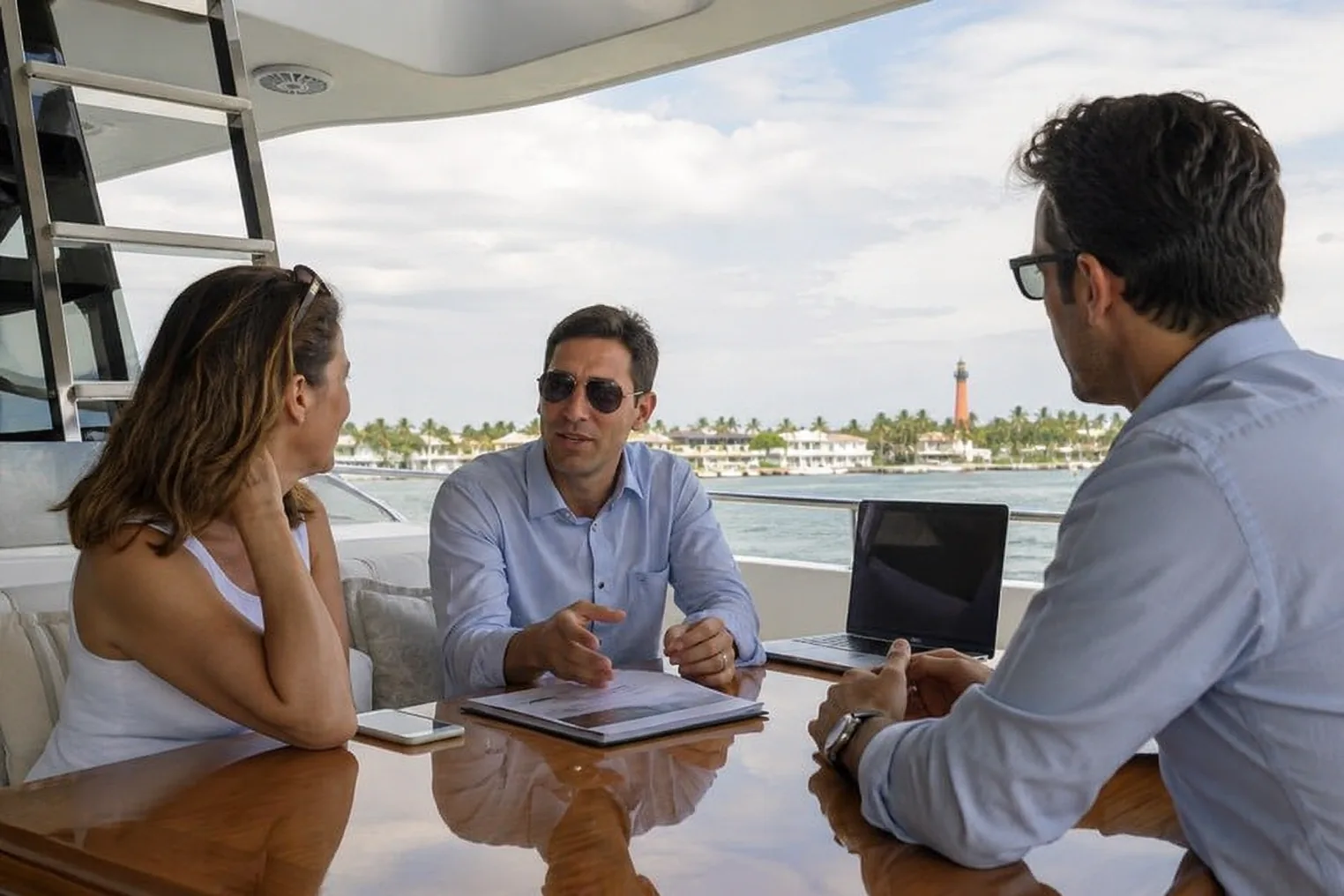
Start with the buyer's risk questions
European builders arriving in the United States tend to lead with design, craftsmanship and heritage. Those attributes matter. Sophisticated American buyers move past them quickly.
Who handles warranty work in Florida? Which yard services her if she never returns to Europe? How quickly do parts arrive? Is the electrical and shore-power strategy appropriate for U.S. use? Who explains importation, delivery and flag choices? Has a U.S. owner already completed this process successfully?
They read like after-sales questions. They behave like purchase objections. A market-entry plan that answers them before the buyer asks converts more effectively than one built primarily around brand awareness.
Define the U.S. competitive set honestly
A 35- to 50-meter European yacht competes in the United States with Italian production and semi-custom builders, with Dutch and German custom yards, with Turkish value propositions, with domestic alternatives, all at the same time. Buyers rarely sort the field into national categories the way the yard does internally.
The positioning therefore needs to be specific. Is the advantage delivery time, customization, volume or speed? Shallow draft, construction quality, interior pedigree, value per gross ton, technical innovation or direct access to senior yard management? 'Italian design and craftsmanship' is probably true. Several competitors say exactly the same thing.
The strongest proposition pairs an emotional reason to want the yacht with an operational reason to trust the builder.
Local representation shortens the sales cycle
A U.S. representative adds value when the buyer reaches the yard faster and with better information. That means knowing the available slots and base specifications, knowing where the customization boundaries sit and how the pricing logic works, and knowing who inside the shipyard actually decides.
Qualifying the buyer before the yard visit is part of the same job. No principal wants to cross the Atlantic to discover that the client wanted a completely different size, had no workable delivery horizon or had never been shown the approximate commercial range.
The representative cannot become a wall, however. UHNW buyers and their advisers eventually want direct access to the yard. A good local model builds continuity before and after those direct relationships form.
Boat shows are a funnel, not a strategy
Fort Lauderdale, Miami and Palm Beach put a European builder in front of the whole buying ecosystem in a few concentrated days: owners and captains, brokers and designers, lawyers, lenders, family-office advisers. That makes shows valuable.
Measure attendance by progression rather than foot traffic. How many qualified owner conversations produced a defined brief? How many led to a private presentation or sea trial? How many became yard visits, slot discussions, letters of intent or specification work?
A yard that spends heavily on hospitality and collects hundreds of contacts without a disciplined post-show process has bought visibility, not market entry.
Build after-sales before the first delivery
The first American owner cannot double as the test case for the builder's service network.
Before the yacht arrives, establish who receives warranty calls, where common spare parts are stocked, which U.S. yards are approved for warranty or service work, how travel for European technicians is handled, and who has authority to approve urgent repairs.
The network may be thinner than a domestic shipyard's. It has to be credible and specific. A buyer will tolerate a specialist technician flying in from Europe on occasion. A buyer is far less comfortable when nobody knows who authorizes the flight.
Localize the product without diluting it
No one is served by redesigning a yacht built for a global owner into an 'American' caricature. Still, U.S. use creates practical questions: shore power and communications, appliances and tender operations, serviceability, spare parts, marina compatibility, the equipment vendors local technicians already know.
Shallow-draft cruising in the Bahamas and Florida carries particular weight with some owners. So do high-capacity air conditioning, strong zero-speed stabilization and tender programs built for beach and watersports use. None of it is universal. It belongs in the brief rather than surfacing after the platform has been selected.
The yard's job is to understand which local requirements affect the ownership experience and which are merely marketing assumptions.
The first owners are infrastructure
An early U.S. delivery does more than generate revenue. It gives the yard a reference vessel, a captain familiar with the product, a service history. It also produces local photography, marina visibility and an owner network that future prospects can verify.
That makes the choice of first owners disproportionately important. A heavily discounted sale to the wrong owner can cost more in reputation than waiting for a better-fit client, while an owner who receives strong support after delivery becomes more persuasive than any advertisement, because the buyer's most important question finally has a credible answer: what is it like to own one here?
Measure the market-entry system
The commercial dashboard follows the actual buying journey: qualified prospects, active briefs, private presentations, yard visits, build-slot discussions, proposal requests, reservations, contracts and post-delivery referrals.
Marketing metrics still matter, but only as leading indicators. Name recognition is a start. Market entry is complete when an American buyer moves from curiosity to contract without encountering a credibility gap the organization is unprepared to answer.
These articles are editorial and educational in nature; they are not legal, tax, customs, insurance or regulatory advice.